
The Saga of Shady Lady
It Was “Trench Warfare” For The Wade Crew
By Allen Ostrom
“That was a magnificent landing.”
Said the co-pilot, Ted Provost, to the pilot, Warren Wade. [See Wade's Crew - 601st Squadron - July/August 1944]
And the circumstances at that moment represented the only high water mark in a day that could only be described as bizarre, wild, fearsome… and deadly.
The landing was made slightly uphill, slightly downhill and over a fence.
“Give me wheels and flaps,” was the last-second cry from the pilot as he made a wing-up, 180-degree turn and set “Shady Lady” down on this unlikely landing field with a touch normally reserved for the movies.
And the setting for this fiction-like episode was in an area of France steeped in the history of World War I, the Alsace-Lorraine region of Verdun, Metz and St. Mihiel.
But this was World War II and the day was September 8, 1944.
The target had been a chemical plant at Ludwigshafen, a city well known to the 398th Bomb Group. Wade and Prevost were on their fifth mission out of Nuthampstead, with a crew of Burt Bream, navigator; William Howell, bombardier; Robert Ritter, engineer; John Rex, radio operator; Wilbert Burns, ball turret gunner; Harrison Brooks, waist gunner; and Eugene Gamba, tail gunner.
Their Fortress was No. 42-97385, a combat veteran of 43 missions. She had left the Seattle Boeing plant in 1942 with just a number. Arriving at Station 131 she took on the letter “X” for easier identification and the number “3-O” to indicate she belonged to the 601st Squadron.
Somewhere along the line a lovely lady was painted on her starboard nose, identified as “Shady Lady”.
Ludwigshafen never appeared in the bombsite of bombardier Howell. Before approaching the IP (Initial Point) No. 1 engine failed and “X” began drifting behind the formation, already “out there” all alone as the squadron’s “tail-end Charlie.”
Moments later No. 2 was out and Wade was on the radio appealing for fighter support as he was unable to maintain either altitude or speed. Wade struggled to not lose sight of the group, led by Major Bruce Daily. He would drop his bombs with the group, if at all possible.
“We kept on as best we could on two engines.” Said Prevost, “but when No. 3 failed we salvoed somewhere in the vicinity of the target. Burt then gave us a heading of 235 degrees, the fastest route toward friendly territory. As I recall, we were heading toward Nancy, which was the area of the front lines at the time.”
At this point the mission turned from simply dangerous to dangerous and bizarre. It was into a heavy cloud cover as the lone operating No. 4 engine did its best to maintain some flight integrity. It was a losing battle, complicated further with the loss of most of the instruments operated by vacuum pumps in No. 2 and 3 engines.
The plane was going down, but nobody really knew how fast or how far. A flash of inspiration led Wade to order engineer Ritter to hold up his earphone cord to help establish some kind of an artificial horizon. Not much help. The plane struggled to stay alive as it wallowed in the murky skies.
“Sometimes we were upside down, sometimes diving and sometimes near stalling,” recalled Prevost. “It was wild, and the tremendous downdrafts had us all guessing. And then our pitot tube had frozen over so we had no idea of our air speed.”
Somewhere during this descent the bombardier chose to bail out and he was followed by the engineer. Both went out the nose hatch.
The wild ride continued for about 40 minutes, when all at once came the “moment of truth.”
A church steeple appeared just ahead. And they were flying upside down!
“Warren and I put our legs on the yoke and pushed, just barely clearing the steeple as we turned the plane right side up.
“Now we were on the deck and the next thing I heard from Warren was ‘wheels and flaps!’”
And the “magnificent” landing… and the beginning of another adventure that would conclude with three of the crew dead in a bloody escape attempt.
The emergency landing was so smooth, the other members of the crew who had huddled in the radio room for the impending crash jolts hardly realized they were safely on the ground.
The joy of the super landing was short-lived, however, as the crew was quickly rounded up by German soldiers. And as these soldiers were ordering the captured seven Americans into a truck, others were cutting branches from nearby trees in an effort to conceal the prized, intact B-17 from the air.
U.S. fighter pilots had standing orders to destroy any bomber that might have survived such a crash landing. It didn’t take them long to find the B-17 and render it junk.
The landing had been successfully negotiated somewhere southeast of Nancy.
“We landed somewhere about half way between Nancy to the west and Sarrebourg to the east,” said Bream. “At least it was 12 kilometers to Nancy, according to the sign post.”
The seven Americans were loaded into an open truck, guarded by five SS troops in the back and two more in the cab. It was now quite dark and soon to begin was a conflict befitting World War I trench warfare of a generation before.
Wade passed the word that they should make an escape try, even in the face of seven armed guards. In the dark, he reasoned, they could make a run for it and reach Allied lines before dawn.
At Wade’s signal, they all jumped the guards and the battle ensued. Tail gunner Gamba threw himself at a guard, only to catch the muzzle of a machine pistol in the stomach. He took “many” rounds and died quickly.
In the wild thrashing of bodies, bullets began flying in all directions. The two guards in the cab also opened up with their machine pistols, their spray firing cutting down one of their own men. But also caught were Wade and Burns.
Prevost was then blinded by a stray bullet and Bream was wounded in the hip. While still standing, a guard landed a rifle butt to his face.
Rex also was flattened with a rifle butt to the face, knocking out many of his teeth.
Thus, the little war was over.
“It was a very bloody truck.”
The living - Bream, Brooks, Prevost and Rex – were herded to a nearby “dungeon,” as Bream called it. As he tried to convince the soldier that he was too weak to walk, he was told flat out –
“Walk or die!”
He walked, but soon almost passed out from loss of blood. Thinking he was about to die he told the others – “So long guys, Nice to have known you.”
Later, in a hospital in Strasboug being treated for his bullet wounds and lacerations, Bream offered high praise for his treatment at the hands of the German medical staff.
They asked him if his wounds were from flak or fighters.
Cautiously, remembering his remarkable air and ground dramas of the preceding hours, he said –
“I’m not sure.”
Bream and Prevost spent the rest of the war at Stalag Luft 1 at Barth. Rex and Brooks were sent to Kief Heide at Pomeria.
Howell and Ritter, who bailed out, made contact with the French Underground, led in that area by Paul Bodot. They were joined by a pair of P-51 pilots, Pierce MacKennon and Ray Reuter, and the four spent several days in an abandoned salt mine. On September 18, guided by Bodot, they made contact with the U.S. 4th Armored Division and soon afterwards were rotated home.
See also:
- Wade's Crew - 601st Squadron - July/August 1944
- Jamaica High School Time Capsule Warren John Weis - later Warren John Wade - Time capsule web page created by Dennis Jensen
- 398th Missions and Descriptions provides further details on various mission dates in the table below
- 398th B-17 Aircraft Photos - scroll this list for 42-97385 for available photos or data on Shady Lady
- Shady Lady Full Crew Listing - downloadable pdf table of B-17G 42-97385 X "SHADY LADY" missions with full crews . Compiled by Lee Anne Bradley. This table is an expansion of the table below. Prints best on legal size paper.
Originally printed in 398th Bomb Group Remembrances by Allen Ostrom, pages 37-38, published 1989.
Transcribed September 2003 by Lee Anne Bradley, 398th Bomb Group Historian.
| No. | Date | 398th Mission | Mission and Target | Sqd | Pilot |
|---|---|---|---|---|---|
| 1 | 05/11/44 | 5 | Sarreguemines, Fr. | 601 | Hadjes, W., 1Lt |
| 2 | 05/13/44 | 7 | Politz, Gr. | 602 | Dollar, J.B., 1Lt |
| 05/19/44 | 8 | Berlin, Gr. | 601 | Hornshuh, 1Lt | |
| 3 | 05/27/44 | 14 | Ludwigshafen, Gr. | 601 | Farnsworth, D., 1Lt |
| 4 | 05/28/44 | 15 | Meissen, Ruhland, Gr. | 601 | Hornshuh, 1Lt |
| 05/30/44 | 17 | Dessau, Gr. | 601 | Rohrer, R.L. | |
| 5 | 05/31/44 | 18 | Mulhouse, Fr. | 601 | Hornshuh, 1Lt |
| 6 | 06/03/44 | 21 | Manihen, Fr. | 601 | Berry Jr, K.L., 1Lt |
| 7 | 06/06/44 | 25 | Courseulles, Fr. | 601 | Dalton, H.L., 2Lt |
| 8 | 06/12/44 | 30 | Lille / Nord, Fr. | 601 | Hornshuh, 1Lt |
| 9 | 06/13/44 | 31 | Beauvais / Tilie, Fr. | 601 | Hornshuh, 1Lt |
| 10 | 06/15/44 | 32 | Bordeaux/Merignac, Fr. | 601 | Hornshuh, 1Lt |
| 11 | 06/18/44 | 33 | Hamburg, Gr. | 601 | Hornshuh, 1Lt |
| 12 | 06/20/44 | 35 | Hamburg, Gr. | 601 | Wierney, J.A., 2Lt |
| 13 | 06/21/44 | 36 | Berlin, Gr. | 601 | Fairbanks, E.J.L, 2Lt |
| 14 | 06/22/44 | 37 | La Vaupaniere, Fr. | 601 | Wierney, J.A., 2Lt |
| 15 | 06/23/44 | 38 | Feifs, Fr. | 601 | Falkenbach, J.J., 2Lt |
| 16 | 06/24/44 | 39 | Belloy-sur-Somme, Fr. | 601 | Berry Jr, K.L., Capt. |
| 17 | 06/25/44 | 40 | Toulouse, Fr. | 601 | Davis, J.A., 1Lt |
| 18 | 06/27/44 | 41 | Biennais, Fr. | 601 | Wierney, J.A., 2Lt |
| 19 | 07/04/44 | 42 | Tours, Fr. | 601 | Hornshuh, 1Lt |
| 20 | 07/06/44 | 43 | Cauchie D'Ecques, Fr. | 601 | Hornshuh, 1Lt |
| 21 | 07/07/44 | 44 | Leipzig, Gr. | 601 | Wilson, G.F., 1Lt |
| 22 | 07/09/44 | 46 | Humieres, Fr. | 601 | Farnsworth, D., 1Lt |
| 23 | 07/11/44 | 47 | Munich, Gr. | 602 | Ryan, J.P. |
| 24 | 07/12/44 | 48 | Munich, Gr. | 601 | Wierney, J.A., 2Lt |
| 25 | 07/13/44 | 49 | Munich, Gr. | 601 | McCarty, W., 2Lt |
| 26 | 07/18/44 | 51 | Peenemunde, Gr. | 601 | Davis, J.H., 1Lt |
| 27 | 07/19/44 | 52 | Lechfeld, Gr. | 601 | Binger, B.L., 1Lt |
| 28 | 07/24/44 | 54 | Montreuil area St.Lo, Fr | 601 | Hornshuh, 1Lt |
| 29 | 07/25/44 | 55 | Montreuil area St.Lo, Fr | 601 | Hornshuh, 1Lt |
| 30 | 07/28/44 | 56 | Merseburg (Leuna), Gr. | 601 | Hornshuh, 1Lt |
| 31 | 07/29/44 | 57 | Merseburg (Leuna), Gr. | 601 | Campbell, R.G., 2Lt |
| 32 | 07/31/44 | 58 | Munich, Gr. | 601 | Stallcup, 2Lt |
| 33 | 08/01/44 | 59 | Melun / Villaroche, Fr. | 601 | Hornshuh, 1Lt |
| 34 | 08/03/44 | 60 | Saarbrucken, Gr. | 601 | Carter, N.B., 2Lt |
| 35 | 08/05/44 | 62 | Dollberg, Gr. | 602 | Boehme, 2Lt |
| 36 | 08/06/44 | 63 | Brandenburg, Gr. | 601 | Blackwell, W, 2Lt |
| 37 | 08/08/44 | 64 | Cauvicourt, Fr. | 601 | Stallcup, 2Lt |
| 38 | 08/09/44 | 65 | Saarbrucken, Gr. | 601 | Farnsworth, D., 1Lt |
| 39 | 08/11/44 | 66 | Brest, Fr. | 601 | Brown, R.E., 2Lt |
| 40 | 08/12/44 | 67 | Versailles, Fr. | 601 | Wierney, J.A., 1Lt |
| 41 | 08/13/44 | 68 | Le Manoir, Fr. | 601 | Taylor, R.O., 1Lt |
| 42 | 08/15/44 | 69 | Ostheim, Gr. | 601 | Marias, S.G., 2Lt |
| 43 | 08/16/44 | 70 | Delitzch, Gr. | 601 | Cucco, J.F., 2Lt |
| 44 | 08/24/44 | 71 | Kolleda, Gr. | 601 | Cucco, J.F., 2Lt |
| 45 | 08/25/44 | 72 | Neubrandenburg, Gr. | 601 | Newman, A.H. |
| 46 | 09/03/44 | 76 | Ludwigshafen, Gr. | 601 | Stallcup, 2Lt |
| 47 | 09/05/44 | 77 | Ludwigshafen, Gr. | 601 | Blackwell, W, 1Lt |
| 48 | 09/08/44 | 78 | Ludwigshafen, Gr. | 601 | Wade, 2Lt |
Notes:
|
| Date | 398th Mission | Notes |
|---|---|---|
| 5/19/44 | 8 | No.3 engine went out over target, came back alone |
| 5/30/44 | 18 | Mission aborted after take-off. A/C landed at Bassingborne with No.3 engine feathered. Airplane was checked at Bassingborne by station engineering officer and No.3 engine was checked OK. Pilot reported that No. 3 oil pressure dropped to 45 pounds and oil temperature went to 100 degrees. Ground check didn't show any defect for that engine. A/C came into this station #131 at 1400, May 30, 1944. All engines ground checked satisfactory. |
| 5/31/44 | 19 | Crew comments on interrogation form: "More food!" |
Roger Lefevre, the local historian, researched Shady Lady, her demise, and her crew. He worked to have a marble memorial made by Mr. Pinheiro to be placed next to St. Martin church in Ley, France, over which Shady Lady flew just before landing in a field next to the village. The memorial funds were provided by the "Conseil General de Moselle" (administrator of the county of Moselle), the "Souvenir Francais" (an association aimed toward keeping alive the memory of men who died for the freedom of France), and private donations from the people of Ley. The dedication for the Monument at Ley was Sept 9, 2006. There is a 2nd monument dedicated to the Shady Lady at Rechicourt, France. Both monuments had special ceremonies involving bands, military, dignitaries, planes flying over the site, people with flags from each village in the county, and more. The Monument at Ley is dedicated to Lt. Warren Wade, Lt. Theodore Prevost, Lt. William Howell, Lt. Burt Bream, Sgt. John Rex, Sgt. Robert Ritter, Sgt. Harrison Brooks, Sgt. Wilbert Burns, and Sgt. Eugene Gamba.
The 398th Memorial Association is very honored by the efforts of Roger Lefevre, Mr. Pinheiro, the "Conseil General de Moselle", the "Souvenir Francais" and the people of Ley for their interest in the Shady Lady crew and their efforts to create the Shady Lady Monument in Ley and to know that those who died there are not forgotten.
See also:
With thanks to Ann Addison, daughter of Warren Wade for the Shady Lady Monument at Ley, France photos and to Sophe Lefevre Nouveau, daughter of Roger Lefevre for the Shady Lady crash landing site photo with Ted Prevost and Roger Lefevre. |
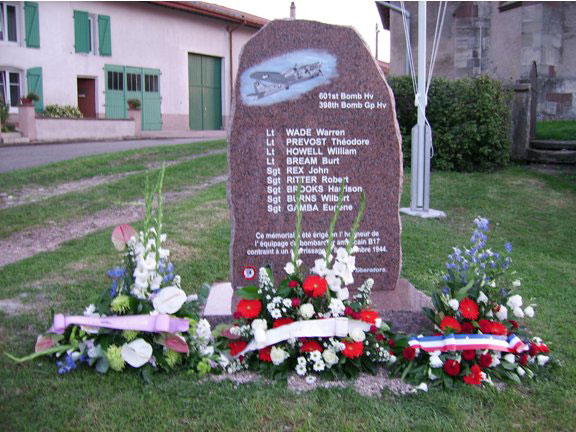
Overview of Shady Lady Monument at Ley, France
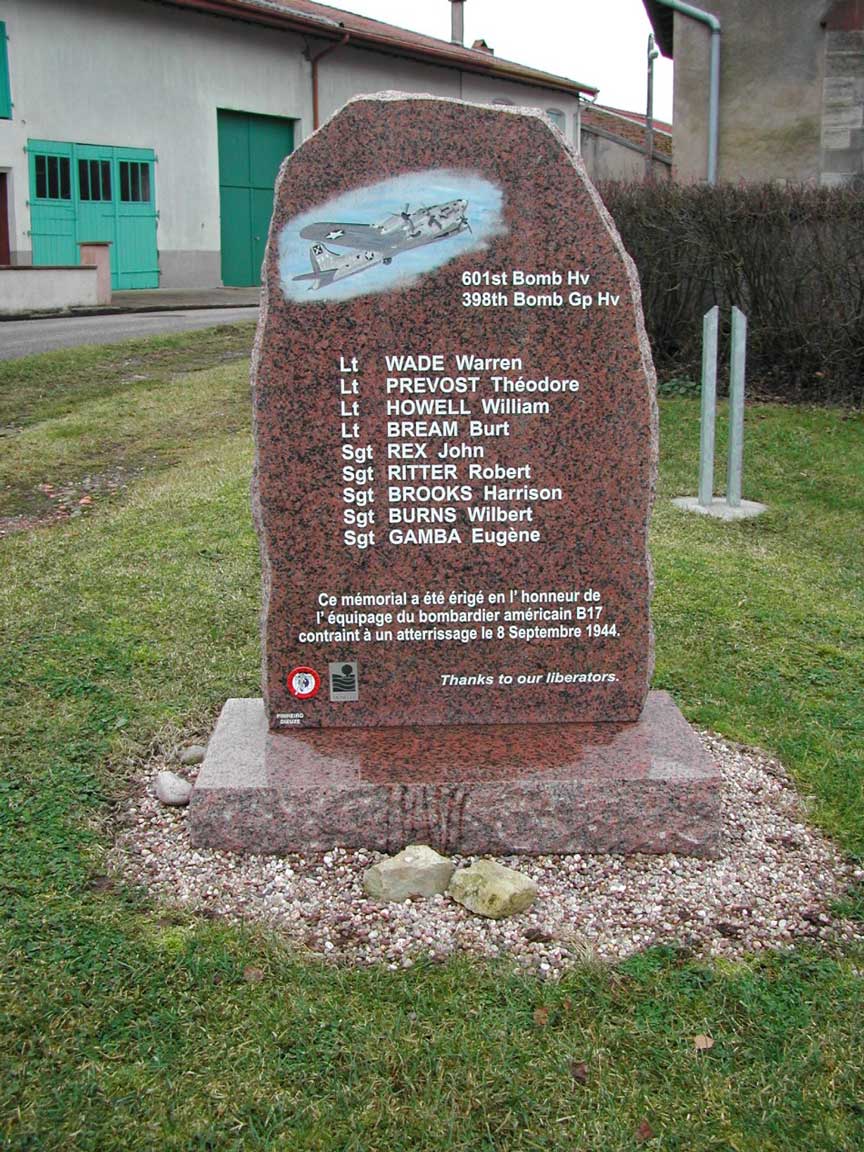
Closeup of Shady Lady Monument at Ley, France
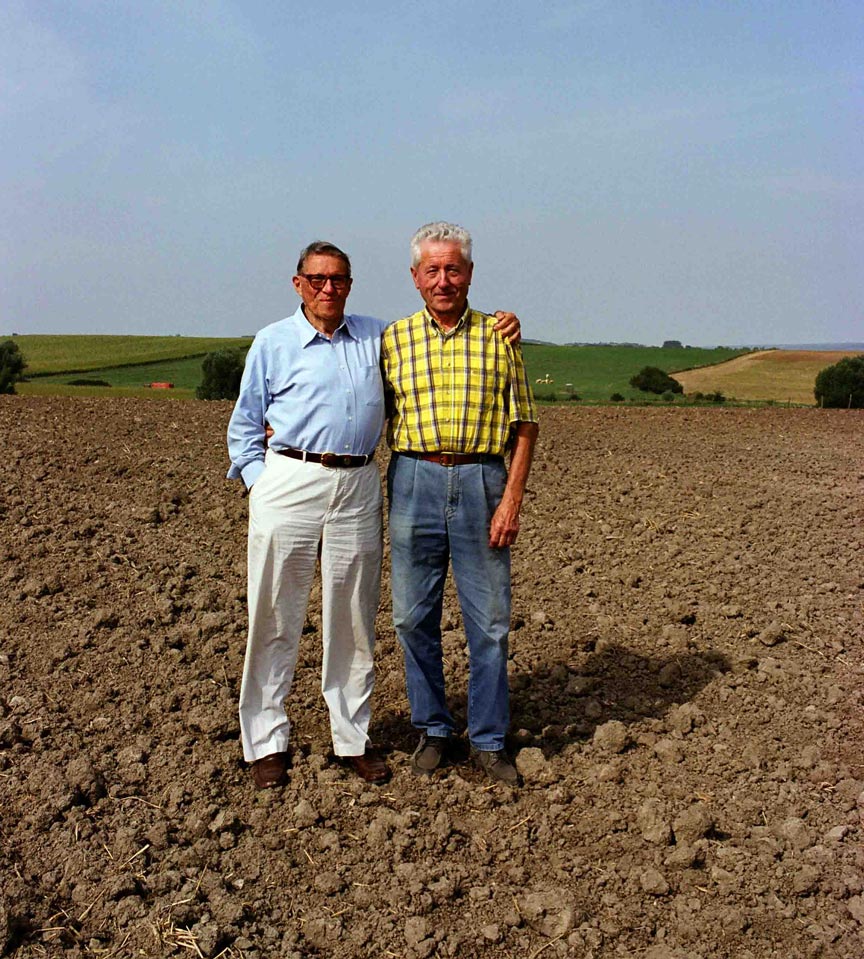
As part of the Ley Memorial Ceremony activities in September 2006, Ted Prevost (Shady Lady Co-Pilot) and Roger Lefevre (local historian) visit the 8 September 1944 crash landing site of the Shady Lady some 60 years before. |
As follows is a note received in August 2009 from Alain Thomassin: Hello, Here are some pictures of this memorial. Thanks to all the American heroes who fought for our freedom. Very best Regards
Jean Marie Heckmann, president of "les Anciens Combattants" (veterans) from Rechicourt, France, initiated the making of the memorial at the attempted escape site. His organization paid for the monument, and he along with Paul Demange chose and placed the memorial. The dedication for the Monument at Rechicourt for the attempted escape was June 5, 2009. There is a 2nd monument dedicated to the Shady Lady at Ley, France. Both monuments had special ceremonies involving bands, military, dignitaries, planes flying over the site, people with flags from each village in the county, and more. The Monument at Rechicourt is dedicated to three members of the Wade Crew. They are: Lt. Warren J. Wade, Sgt. Wilbert Y. Burns, and Sgt. Eugene Gamba.
The 398th Memorial Association is very honored by the efforts of Jean Marie Heckmann, "les Anciens Combattants", Paul Demange, and Alain Thomassin for their interest in the Shady Lady crew and their efforts to create the Shady Lady Monument in Rechicourt Le Chateau and to know that those who died there are not forgotten.
See also:
With thanks to Alain Thomassin for the Shady Lady Monument at Rechicourt, France photos. |
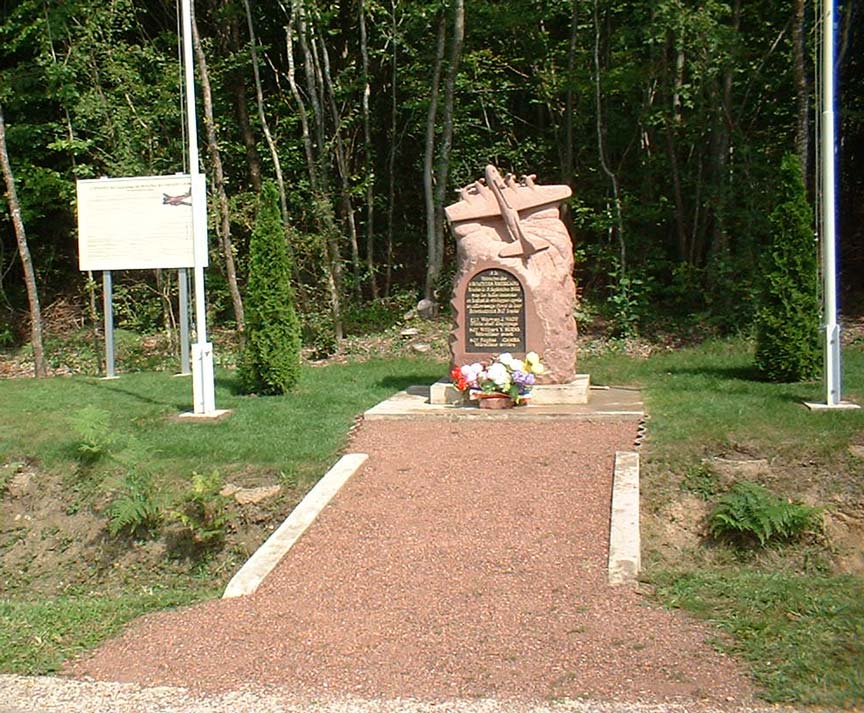
Overview of Shady Lady Monument at Rechicourt Le Chateau, France
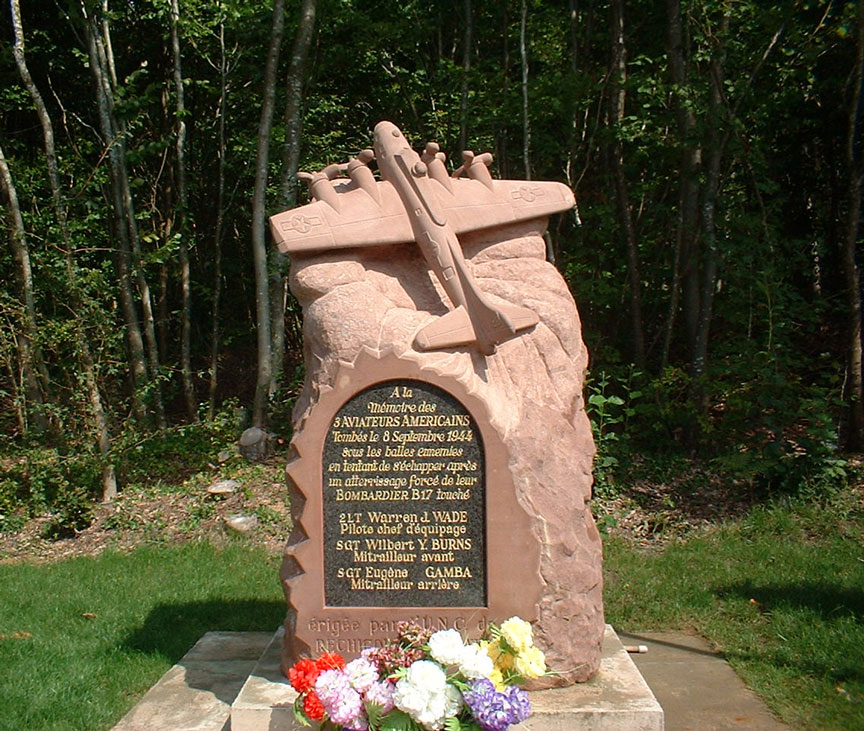
Dedicated to the memory of Lt. Warren J. Wade, Sgt. Wilbert Y. Burns, and Sgt. Eugene Gamba. |